
Precision Die Cutting Services

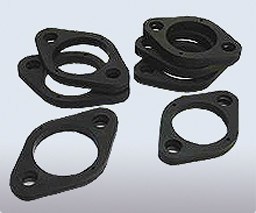
Every sealing system, bumper, and gasket in a finished product had to be cut correctly. An experienced team evaluates your print, your material, and your volume, then selects the punch press, rotary, or steel rule configuration that produces the part most efficiently. Whether you are validating a prototype or releasing hundreds of millions of components, you get the same IATF 16949:2016-certified process controls and the same customer service team working to keep your program on schedule. At Clark Rubber and Plastic, our team assists manufacturers in the solar, automotive, appliance, medical, and military markets; we turn certified rubber and gasket stock into components that fit and hold their tolerance.
Punch Press, Rotary, and Steel Rule
Punch press die cutting demands tight, repeatable dimensional control; this is best for geometries with internal features like bolt holes, slots, or notches that must locate precisely relative to the outside profile. Rotary die cutting runs material continuously from roll stock, making it an option for high-volume gaskets, spacers, and adhesive-backed components. Steel rule die cutting is ideal for larger profiles, thicker cross sections, and lower-to-medium volume programs where a faster, more affordable tool gets you to production sooner without sacrificing edge quality.
Our master toolmakers build tooling in-house, so die design decisions happen in the same building. That helps shorten the loop between a print revision and a corrected first article, and it removes an outside tooling vendor and lets us adjust clearances, cutting angles, and nesting layouts. It also reduces scrap on your specific material. On a high-volume gasket program, a smarter layout can change your material yield and your annual spend, and those savings compound every year the part stays in production.
Materials, Tolerances, and Inspection
We source certified rubber and gasket sheet materials from trusted vendors and maintain documentation to prove what went into your parts. Elastomers behave differently under a cutting edge depending on durometer, thickness, and backing, so material selection is part of the engineering conversation. Parts are inspected using optical comparators to verify the profile against your drawing, and material is verified with durometer gauges to confirm hardness falls within specification.
We accept files in AutoCAD, SolidWorks, and CATIA, so your engineering team can send data in the format they already use. If you are still refining the design, send us the concept and our team will offer manufacturability feedback on radii. We also offer web thickness and tolerance callouts before you commit to a tool.
At Clark Rubber and Plastic, our staff holds Six Sigma certification at the Yellow, Green, and Black Belt levels, giving us a shared method for finding the root cause of a quality issue. We also work to ASTM and Rubber Manufacturers Association standards where your application calls for them.
All of this runs inside a facility built around continuous improvement, defect prevention, and waste minimization. That means your first article report and inspection data are documented and traceable to the specific lot and run that produced your parts. If a question comes up six months into production, we can answer it with records.
Industries, Applications, and Services
Some services include structural components, optical lenses, clamping mechanisms, and gaskets of every description. Those parts ship to various sectors, including alternative energy and industrial applications. Because we support a broad mix of industries, we know a solar mounting gasket and an appliance sealing component are judged by different criteria, so we build inspection plans around compliance certification and adjustable designs.
Automotive programs bring PPAP expectations and volume ramps. Military and defense work brings documentation and traceability requirements. Medical customers need batch-to-batch consistency validated. Same presses, different controls, and different compliance criteria.
We also finish and prepare parts, so they arrive ready for your assembly process. Film and tape application, splicing, notching, kitting, and more are available in-house. Grouping related components into a single organized package reduces the number of part numbers your team handles on the floor and cuts down on line-side errors. At Clark Rubber and Plastic, our team also offers plastic extrusion, plastic injection molding, rubber molding, precision machining, and CNC turning; you can consolidate multi-process assemblies with one supplier instead of coordinating across several.
Frequently Asked Questions
Which die cutting method is right for my part?
It depends on volume, material thickness, part size, and tolerance. High-volume parts running from roll stock usually favor rotary die cutting for speed and cost per piece. Parts with tight dimensional requirements and internal features are better suited to punch press work. Larger profiles, thicker materials, and shorter runs often make the most sense on steel rule tooling because the tool is faster to produce. Send us your print and target annual volume, and we will recommend the configuration that fits, along with the reasoning behind it.
Can you handle both prototypes and high-volume production?
Yes. Our production volume range runs from prototype quantities through high-volume production, and projects at both ends receive the same attention to detail and quality standards. Many customers start with us at the prototype stage and stay through launch and full production, which means the team that helped refine the design is the same team running the job years later.
What lead times should I expect?
We specialize in quick turnarounds, and actual lead time depends on whether tooling already exists, material availability, and the finishing services your part requires. Repeat orders on existing tooling move fastest. New programs require tool build time, which our in-house toolmaking shortens compared to suppliers who outsource that step. If you are working against a firm launch date, tell us early, and we will build the schedule from it.
Request a Quote for Your Die Cutting Program
At Clark Rubber and Plastic, our job is to deliver die-cut parts that are consistent and precise, so your engineering and quality teams can spend their attention where it’s needed. Send your drawings, describe your application, and tell us what volume you need, and our team will respond with a competitively priced quote and honest feedback on how to improve the part. Call 440-255-9793, email mike@clarkrandp.com, or request a quote online to get started.
PRECISION DIE CUTTING CAPABILITIES
| Die Cutting Method | Punch Press |
| Form | Sheet |
| Materials | Rubber |
| Applied | Film |
| Tolerance | High Precision |
| Inspection | Optical Comparators |
| Testing | Durometer Gauges |
| Quality | Certified Materials |
| Additional Services | In-House Tooling |
| Production Volume | Prototype to High Level Production |
| Typical Lead Time | Quick Turnaround |
ADDITIONAL INFORMATION
| Industry Focus | Solar |
| Intended Application | Structural |
| Industry Standards | ISO/TS 16949:2009 3rd Edition |
| Efficiency | Six Sigma Certification
|
| File Formats | AutoCAD |